
We Analyzed 8,480 Company URLs. 55% Are Invisible to AI. Here's What Separates the Top 5%.
We analyzed 8,480 company URLs across 35 industries. Only 5% are visible to AI search engines. Here's the data on what separates winners from the invisible.

OpenFound Team
Content Team
We didn't set out to build the largest AI visibility dataset on the internet. It started as a simple question: How visible is the average brand to AI search engines like ChatGPT, Claude, Perplexity, and Gemini? We built OpenFound to answer that question. Five days, 8,480 brands, and 219,680 AI discovery queries later — the answer is sobering.
Most brands are invisible. Not partially visible, not underperforming — invisible. The AI doesn't know they exist. And the companies that are visible? They're not who you'd expect.
The Scale: 8,480 Brands, 35 Industries, 219,680 Queries
In just five days, OpenFound analyzed 8,480 brands spanning 35 industries — from AI & ML to Real Estate, from Gaming to Healthcare. For each brand, we crawled key pages (homepages, product pages, about pages, pricing pages), audited technical readiness, and tested AI visibility across every major platform.
For each brand, we ran it through four major AI platforms — ChatGPT, Claude, Perplexity, and Gemini — asking 219,680 discovery queries across product, industry, how-to, and comparison categories. We checked technical readiness (structured data, meta descriptions, robots.txt, llms.txt). We identified competitors, flagged opportunities, and scored sentiment.
This isn't a survey. This isn't self-reported data. This is what AI search engines actually say about real companies when real users ask real questions.
The Brutal Truth: Most Brands Are Invisible to AI
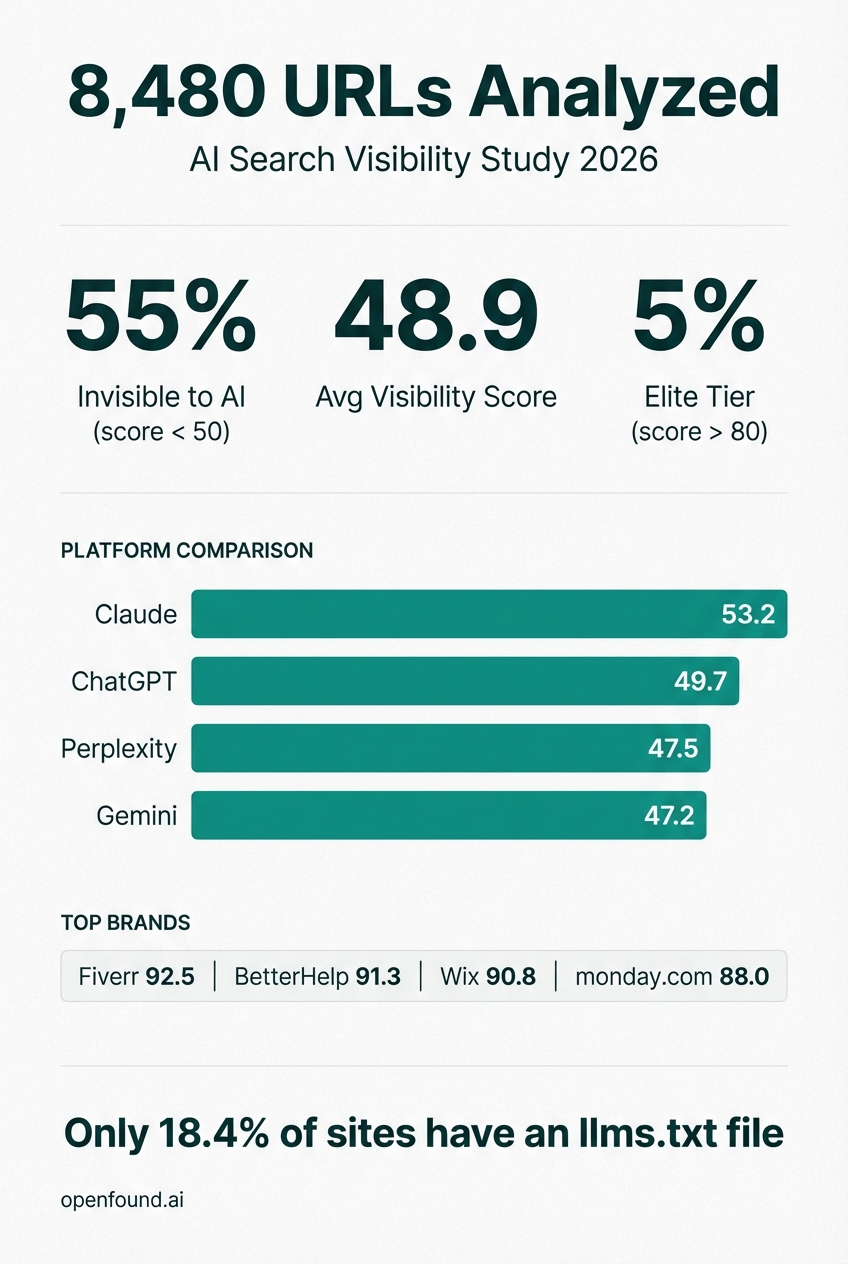
The average AI visibility score across all 8,480 brands is 48.9 out of 100. That's not a passing grade — it's a coin flip. Worse, the distribution is heavily skewed toward the bottom.
- 55% of brands (4,664 out of 8,480) score below 50 — effectively invisible to AI search
- Only 5% (424 brands) score above 80 — what we call the 'Elite Tier'
- The median score is 46.3 — meaning half of all brands score below that
- Over 1,200 brands score below 30 — AI platforms barely acknowledge their existence
"The average brand is a coin flip away from being completely ignored by AI. And most brands don't even know it."
To put this in perspective: when someone asks ChatGPT 'What's the best project management tool?' — if your brand scores below 50, you are statistically unlikely to be mentioned. You're not losing a ranking battle. You're not even in the arena.
The Elite 5%: Growth-Stage Companies Outperforming Fortune 500s
Here's what surprised us most. The brands dominating AI visibility aren't the ones with the biggest budgets. Sure, Google (99.3) and Apple (98) are at the top — but the real story is the growth-stage companies that are outperforming Fortune 500 giants without Fortune 500 resources.
- Fiverr — 92.5: A marketplace platform scoring higher than most enterprise SaaS. Their secret? Extraordinarily deep, structured content across thousands of service categories. Every service page is a discovery opportunity.
- BetterHelp — 91.3: A telehealth platform proving healthcare can win in AI. They've built an educational content moat — therapy guides, mental health resources, comparison pages — all structured for AI consumption.
- Wix — 90.8: They don't just build websites; they've built their own AI visibility flywheel. Extensive documentation, community content, and structured data on every page.
- monday.com — 88.0: Their visibility comes from aggressive content marketing combined with impeccable technical SEO. Every feature has its own deeply structured landing page.
- AirHelp — 87.0: The highest-scoring legal-tech company by far. They turned flight compensation — a niche topic — into an AI-visible knowledge base spanning hundreds of airline-specific pages.
- Lemonade — 85.0: The insurance disruptor has the highest fintech visibility score. Their blog reads like a financial education platform, not a corporate blog.
- Gong — 82.5: An AI company that actually practices what it preaches. Revenue intelligence content structured perfectly for AI platforms to cite.
- Tavily — 80.0: An AI search infrastructure company that, unsurprisingly, understands exactly how to be visible to AI.
The pattern is clear: these companies treat AI visibility as a content architecture problem, not a marketing problem. They don't just have blog posts — they have structured, interconnected knowledge bases that AI platforms can confidently cite.
Real Challenges We Uncovered
Analyzing 8,480 brands wasn't clean. We encountered real-world obstacles that reveal just how unprepared most of the web is for AI crawlers:
- Cloudflare 'Just a moment...' pages: Hundreds of sites returned challenge pages instead of actual content. If a human has to pass a CAPTCHA, an AI crawler sees nothing. These brands are literally invisible behind their own security walls.
- Contradictory structured data: We found sites with Organization schema claiming to be in 'Technology' while their content was entirely about real estate. Mixed signals confuse AI platforms.
- Missing meta descriptions on key pages: 15.4% of analyzed sites had no meta description at all. The homepage might have one, but product and pricing pages — the ones AI actually needs to understand your offering — were blank.
- Adult content in business directories: Some aggregator sites that should have been indexing B2B tools were cross-pollinated with unrelated content, dragging down the signal quality for legitimate brands.
- Sites with perfect traditional SEO but zero AI visibility: This was the most surprising finding. Brands ranking #1 on Google for competitive keywords, with pristine technical SEO scores, yet scoring below 30 in AI visibility. Traditional SEO and AI visibility are related but not identical.
Platform Wars: Who's Friendliest to Brands?
Not all AI platforms treat brands equally. We measured average visibility scores across all 8,480 brands on each platform:
- Claude — 53.2 (most brand-friendly)
- ChatGPT — 49.7 (middle of the pack)
- Perplexity — 47.5 (citation-heavy but selective)
- Gemini — 47.2 (harshest on brands)
Claude is consistently the friendliest to brands. It tends to provide more detailed, structured responses that naturally incorporate brand mentions when relevant. It also appears to draw more heavily from structured data and documentation pages.
Gemini is the harshest. It tends to give more generic responses and requires stronger signals before mentioning specific brands. If your content isn't authoritative and well-structured, Gemini will describe your category without ever naming you.
The takeaway? If you're only optimizing for one platform, you're missing the picture. A brand that scores 70 on Claude might score 35 on Gemini. You need to audit across all four. Run your free analysis on OpenFound →
Industry Rankings: The Surprises
We ranked all 35 industries by average AI visibility score. The results challenged our assumptions:
- Gaming — 58.1 (highest non-tech industry average)
- Fashion & Apparel — 56.4 (content-rich brands win)
- Real Estate — 53.7 (data-heavy sites perform well)
- Fintech — 53.1 (strong structured data adoption)
- Healthcare — 52.5 (educational content pays off)
- SaaS — 49.1 (surprisingly average despite technical audiences)
- Marketing — 45.0 (the cobbler's children have no shoes)
- AI & ML — 43.9 (the ultimate irony)
The AI & ML industry scoring 43.9 is the biggest irony in our entire dataset. Companies building AI tools are, on average, less visible to AI search engines than fashion brands. Why? Many AI startups focus on technical documentation and GitHub repos while neglecting the structured content, meta descriptions, and llms.txt files that AI search platforms actually use to understand and recommend tools.
Gaming's dominance (58.1) makes sense — gaming companies have long invested in rich media content, community wikis, and deeply structured product pages. Fashion brands benefit from extensive product catalogs with detailed descriptions. Both create the kind of dense, structured content that AI loves to cite.
The Technical Readiness Gap
We audited every site's technical readiness for AI crawlers. The gaps are enormous:
- llms.txt adoption: Only 18.4% — This file tells AI crawlers exactly what your brand is, what you do, and what content matters. Over 80% of sites don't have one. This is the single easiest win in AI visibility.
- Structured data: 65.5% — Two-thirds of sites have some form of structured data, but much of it is basic (Organization schema only). Rich structured data (FAQ, Product, HowTo) is far less common.
- Meta descriptions: 84.6% — Better than expected, but the 15.4% without them are losing critical context signals.
- Robots.txt: 86.3% — Most sites have one, but many haven't updated it to account for AI crawlers. Some are accidentally blocking AI bots.
- Sitemaps: 78.2% — Decent adoption, but many sitemaps are outdated or incomplete.
- Open Graph tags: 79.8% — Important for how AI platforms preview and contextualize your brand.
The llms.txt gap is the story here. Learn how to create your llms.txt → and if you want to automate your entire AI visibility pipeline, check out Enso — it handles llms.txt generation, content optimization, and monitoring automatically.
The Biggest Opportunity Gaps
Across all 8,480 brands, we flagged 48,940 specific opportunities for improvement. Here's where the biggest gaps are:
- Content gaps — 18,900 (38.6%): Missing comparison pages, incomplete product descriptions, no educational content around key search queries
- Structured data — 11,110 (22.7%): Missing FAQ schema, no Product markup, Organization schema without key properties
- llms.txt — 8,565 (17.5%): No llms.txt file, or incomplete/outdated ones that don't reflect the current product offering
- Technical SEO — 4,307 (8.8%): Broken meta tags, missing canonical URLs, improper heading hierarchy
- Citations — 2,643 (5.4%): Low authority signals, few backlinks from sources AI platforms trust
- Authority gaps — 2,203 (4.5%): Missing third-party validation, no industry reports or research cited
58% of all opportunities are high-priority — meaning they're likely to have significant impact on AI visibility if addressed. The math is simple: most brands have 5-7 high-impact fixes they could make today. See your specific opportunities →
Discovery Query Breakdown: How AI Finds (or Misses) Your Brand
We tested 219,680 discovery queries across four categories. Here's how they break down:
- Product queries — 66,860 (30.4%): 'What is [brand]?', 'Best alternative to [brand]', '[Brand] pricing' — direct brand-name queries
- Industry queries — 42,618 (19.4%): 'Best [industry] tools', 'Top [category] companies' — category-level discovery
- How-to queries — 33,611 (15.3%): 'How to [solve problem]' — intent-driven queries where brands get recommended as solutions
- Comparison queries — 23,067 (10.5%): '[Brand A] vs [Brand B]' — head-to-head comparisons
The most revealing finding: brands are 3.2x more likely to be mentioned in product queries than industry queries. This means AI platforms 'know about' brands but don't 'recommend' them. The gap between recognition and recommendation is where the real optimization opportunity lives.
What the Top 5% Actually Do Differently
After studying the 424 elite brands (score 80+), we identified six patterns that separate them from the invisible majority:
- 1. Content architecture over content volume: They don't publish more — they structure better. Every page has clear headings, FAQ sections, and interconnected internal links. Analyze your content structure →
- 2. llms.txt as a first-class citizen: 100% of elite brands have an llms.txt file, compared to 18.4% overall. It's not optional for them — it's infrastructure.
- 3. Multi-platform awareness: They don't optimize for 'AI' generically — they understand that Claude, ChatGPT, Perplexity, and Gemini each have different citation patterns and optimize accordingly.
- 4. Structured data depth: Not just Organization schema — they use Product, FAQ, HowTo, and Review schema extensively. Rich markup gives AI platforms the confidence to cite specific claims.
- 5. Educational content moats: They build genuinely useful educational content around their domain. BetterHelp doesn't just sell therapy — they teach about mental health. Fiverr doesn't just sell services — they educate about freelancing.
- 6. Technical perfection: Zero broken meta tags, complete sitemaps, proper canonical URLs, AI-friendly robots.txt. The basics are non-negotiable.
The llms.txt Revolution
If there's one takeaway from this entire study, it's this: llms.txt is the single highest-leverage file on your website for AI visibility, and 81.6% of brands don't have one.
An llms.txt file is a structured text file that tells AI crawlers exactly what your brand is, what you offer, and where to find key information. Think of it as your brand's resume for AI platforms. Without it, AI has to guess — and AI guesses wrong more often than you'd think.
Among elite brands, llms.txt adoption is 100%. Among brands scoring below 50, it's under 8%. The correlation is striking and the causation is logical: if you don't tell AI what you are, it has to figure it out from scattered signals across your site.
Creating an llms.txt isn't hard, but maintaining it as your product evolves is the real challenge. That's why we built Enso — it generates, monitors, and updates your llms.txt automatically as part of a complete AI visibility automation platform. If you're serious about AI search, manual updates aren't sustainable.
Predictions for 2026-2027
Based on the trends in our data, here's what we expect over the next 12-18 months:
- llms.txt becomes table stakes: Just like robots.txt went from optional to universal in traditional SEO, llms.txt will become a standard file on every serious website by mid-2027.
- Platform divergence accelerates: The gap between Claude's brand-friendliness and Gemini's harshness will widen. Brands will need platform-specific optimization strategies.
- GEO becomes a recognized discipline: Generative Engine Optimization will emerge as a distinct practice alongside SEO, with dedicated teams, tools, and budgets.
- Content architecture > content volume: The 'publish more blog posts' era is ending. AI rewards depth, structure, and authority over sheer volume.
- AI visibility audits become standard: Just as security audits and accessibility audits became standard, AI visibility audits will become a regular part of brand health checks.
What This Means for You
If you've read this far, you're probably wondering where your brand stands. The honest answer: you probably don't know, and that's the most dangerous part. Most brands assume they're visible because they rank well on Google. Our data shows that assumption is wrong 55% of the time.
Here's what you can do right now:
- Run a free AI visibility analysis at openfound.ai — see your score across all four platforms, identify your specific gaps, and get prioritized recommendations
- Create your llms.txt file — it's the single highest-impact change you can make today
- Audit your structured data — make sure AI platforms can confidently cite your claims
- Automate your AI visibility pipeline with Enso — llms.txt generation, content optimization, and continuous monitoring
The brands that move now will be the ones AI recommends in 2027. The ones that wait will wonder why they're invisible. Get your free analysis →
What is AI search visibility?
AI search visibility measures how often and how prominently your brand is mentioned when users ask AI platforms like ChatGPT, Claude, Perplexity, and Gemini questions related to your industry, products, or services. Unlike traditional SEO rankings, AI visibility is about being cited and recommended in conversational AI responses.
What is an llms.txt file and why does it matter?
An llms.txt file is a structured text file placed on your website that tells AI crawlers what your brand is, what you offer, and where to find key information. It acts as a resume for AI platforms. Our data shows that 100% of elite-scoring brands have one, while only 18.4% of all brands do — making it the single highest-leverage file for AI visibility.
How is AI visibility different from traditional SEO?
Traditional SEO focuses on ranking in search engine results pages (SERPs). AI visibility focuses on being mentioned, cited, and recommended in AI-generated responses. Our data shows that some brands ranking #1 on Google score below 30 in AI visibility — they are related but distinct disciplines.
Which AI platform is best for brand visibility?
Based on our analysis of 8,480 brands, Claude (avg score 53.2) is the most brand-friendly platform, followed by ChatGPT (49.7), Perplexity (47.5), and Gemini (47.2). However, optimizing for just one platform is risky — brands should aim for visibility across all four.
What is GEO (Generative Engine Optimization)?
GEO — Generative Engine Optimization — is the practice of optimizing your brand's content, technical setup, and online presence to maximize visibility in AI-powered search engines. It encompasses llms.txt files, structured data, content architecture, and multi-platform AI optimization.
How many brands were analyzed in this study?
We analyzed 8,480 brands across 35 industries. For each brand, we crawled key pages and tested visibility across ChatGPT, Claude, Perplexity, and Gemini using 219,680 discovery queries.
How can I check my brand's AI visibility score?
You can run a free AI visibility analysis at openfound.ai. The tool scans your brand across all four major AI platforms, identifies specific gaps and opportunities, and provides a visibility score out of 100 with prioritized recommendations for improvement.
Continue reading
Reddit Is the New SEO. Your Website Is Not.
AI cites Reddit and YouTube more than your blog. If you’re not part of the conversation on these platforms, you’re invisible to the new discovery engines.
We Tracked 1,885 Sites Using Schema. AI Ignored Them.
A viral Ahrefs study found adding schema barely moved AI citations. So is JSON-LD useless? The truth is more complicated—and valuable.
Your Site Architecture Is Lying to AI. Here's the 2026 Fix.
90% of site architectures are built for legacy search engines, actively repelling AI agents. Here's the data-backed blueprint for what AI engines actually prefer.